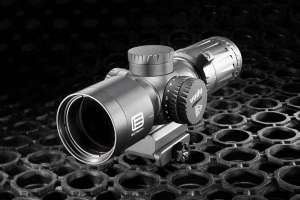

Once the domain of law enforcement and military rifles, technologically enhanced firearm aiming systems such as red-dot optics are not only fully mainstream now, but also better than ever, with many designed for handguns as well. Your customers may be well-versed in the advantages of these types of optics, but since the technology is advancing so quickly, retailers should keep some foundational concepts in mind while navigating sales opportunities. Admittedly, a lot of subjective factors come into play when interacting with customers on their red-dot needs.
As you know, red-dots are meant to aid in aiming a firearm or other weapon, affording a faster time to acquire a target and fire. Additionally, they provide the ability for a shooter to keep both eyes open during aiming, allowing for a broader field of view and thus greater ability to see what’s happening around or near a target, not overly focusing on the target itself. The red ‘dot’ — or whatever other shape the reticle may take — also provides an easier means for eyes to see where a firearm is aimed compared to traditional fixed sights, even as these may remain a part of the weapon. In short, red-dot features are meant to provide a tactical advantage to a shooter.
As with most hand/eye weapons systems, some of these tactical advantages are not as advantageous for some. As such, a few basic questions and answers may help keep some important things in focus as you talk with your customers about red-dots.
What’s the Best Lens Size?
As with many aspects of personal firearms, factors such as size and portability come into play, requiring balance. A red-dot optic’s lens, of course, needs to be large enough to be useful to a shooter but small enough to remain lightweight and maneuverable. How this plays out will vary for red-dots meant for rifles or other long guns versus those meant for handguns. Generally, the larger the lens, the easier it will be to look through. Red-dot optics meant for long guns seem to have more variance in size than those meant for handguns — you’ll see larger and smaller lenses for long guns but smaller lenses for handguns.
So what’s the best lens size? It’s the one that works for your customer. And rather than getting into subjective notions of size, a recommended sales technique would simply be to have multiple-sized red-dot variants on hand for customers to test, preferably pre-installed on a weapons platform that is a part of their arsenal.
What’s the Best Size and Style for the Dot or Reticle?
The dot, of course, isn’t always a dot. Sometimes it is a cross hair or other style of reticle. At times, it may even be a different color. The point is, again, to find the one that works best for a customer in their context. Law enforcement or military organizations may require a certain make, model or even reticle style; as such, customers may just have to train to that standard. Other customers may be able to choose. Some red-dot optics offer multiple reticles a shooter can choose from, simply by adjusting some settings on the device itself. In any case, in addition to considering the size of the reticle, the matter of the reticle’s brightness comes into play, bringing other variables worth considering. Dialing up the brightness of the reticle makes it easier to see in bright lighting conditions but can actually obscure the target (or portions thereof) at certain distances. As for style, is a single red dot superior than other styles of reticle? Some reticles leave open the actual target area while surrounding it with other graphics that allow better target identification and shot placement. What’s best for any given customer will vary, of course.
How Durable Should It Be?
Red-dot durability —the optic’s ability to withstand the continued harsh treatment associated with sitting atop a firearm used in tactical, military or other purposes — can also be subjective, even though military standards provide some kind of baseline. Of course a weapon-mounted aiming system needs to be robust, just as every other part of the weapon should be. Some red-dots can really take a beating, far more than any number of tactical efforts may ultimately bring to bear on it. Some can be dropped and even have the lens crack but still put a recognizable reticle in the glass a shooter can rely on when aiming. At some point, however, every mechanical or electronic thing will fail. That’s not a knock against durability, per se; but it makes it ultra-important that shooters keep realistic expectations of their equipment and also check and double-check constantly for overall functionality.
What About External Controls?
Some red-dots feature an external power switch — a rotating dial, a single dedicated button, two recessed buttons that must be pressed at the same time, or something else. There’s no right or wrong design; there are subjective advantages and disadvantages to each. For the rotating dial, it’s possible (albeit unlikely) that a shooter may bump the dial and accidentally change the brightness or even power down the optic, making the red dot go away. But a rotating dial is intuitively easy to understand and manipulate, even with gloves on. For a single, dedicated button, the advantage is its simplicity. Push it to power up or down. If the button does nothing else, then some other controls are likely needed to make other changes. Depending on the size and location of the button, gloves may be a factor. For the two recessed buttons, they’re well protected from any bumps that may accidentally press in, but they may be difficult to manipulate with gloved hands.
Other controls, such as those to adjust windage and elevation, may also be part of the optic, and these may be exposed or hidden. And they may require an Allen wrench or other tool in order to change. Again, no right or wrong here; just circumstances to be aware of as customers evaluate their options. A robust sales process may include providing a customer with gloves along with an in-store demo of the optic to help make the point.
Can It Co-Witness?
Some red-dots allow a shooter to also use a firearm’s traditional sights. On a handgun, the rear sights may sit right behind the red-dot lens and the front sight is in front of the red-dot, in its normal location at the front of the muzzle. Some handguns provide a taller front sight that’s more easily seen when looking through the red-dot lens. This setup, of course, provides for aiming via the traditional sights even though equipped with a red-dot. Help your customers think through some of the issues associated with co-witness sights. A taller front sight may be more prone to snag on something. Co-witness sights may seem to clutter a shooter’s view, even as they’re meant to be an aid in aiming. Yet some handgun red-dots are meant to be left powered on indefinitely — as such, there will be a point when the battery runs out.
Long guns may sport a red-dot as well as other sighting devices, such as a magnifier or even iron sights. Some shooters mount these on the top rail; others choose an angled side rail so they can switch between sighting systems by merely turning the firearm an eighth of a turn to the right or left, allowing for quick sighting changes between targets of varying distances.
How Else Can You Help Customers?
Red-dots come with additional needs for various types of gear. Handguns equipped with red-dots may require a holster with a cutout adapted for the red-dot. Long guns equipped with red-dots may require a soft case with additional height to accommodate the optic. Backup batteries may be needed at some point, although some red-dots can go years without a new battery. For those with shorter battery lifespans, a new backup battery is a good addition to the kit. Additionally, red-dots have lenses, and lenses need to be kept clean — cleaning solution and wipes may be in order. Many red-dots may come with the tools needed to make adjustments, such as a single Allen wrench to tighten a mount or another Allen wrench to adjust windage and elevation. These easily disappear, so a multitool with all the right tools built in may be a good addition as well. If the red-dot comes off the weapon, a padded storage bag may be helpful, too.
Finally, most of your customers may already have opportunities for training available to them. If not, team up with a local training professional to offer some instruction on the ins and outs of using a red-dot.
Four Red-Dots to Stock
MEPRO MPO-S
MEPRO’s new-for-2025 MPO-S is engineered with a sleek, low-profile design to minimize the risk of snags, ensuring a faster draw and quicker target acquisition. With shake-away, over two years of battery life and a RMSc footprint — allowing for direct mounting to your favorite concealed carry handgun — the MPO-S will be there for customers when it counts. A selectable three-segment reticle (3-MOA dot, 33-MOA bull’s-eye, and 33-MOA ring) allows shooters to tailor how they interact with the optic.
EOTECH EFLX Mini
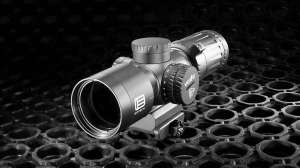
The heavy-duty aluminum housing on EOTECH’s EFLX makes this a durable option, configured to the Leupold Delta Point Pro footprint (it will also adapt to appropriately milled slides or onto a rear dovetail mounting adapter). Shooters select a 3- or 6-MOA aiming dot. A single 2032 top-loads and offers roughly 20,000 hours of run time — over two years. The brightness adjusts from eight daytime settings and one night-vision setting.
Sightmark Mini Shot A-Spec M2
Simple yet robust, Sightmark’s Mini Shot A-Spec M2 is a minimalist sort of option but has plenty of features, including a 1- and 5-MOA dual dot reticle system, six daytime and three night-vision brightness settings, a compact open sight design, and waterproof construction. It uses the popular RMR footprint.
Trijicon RMRcc
Specifically designed for concealed carry, this slimmed-down version of the RMR has a low-profile design to reduce the risk of snags for a fast draw. The buttons are easy to use, the battery life is up to four years, and a wide variety of mounts are available to fit today’s popular concealed-carry pistols. Choose from a 3.25- or 6.5-MOA dot and select from eight brightness settings, including a super-bright mode and two night-vision modes.