
“By special authorization, the CMP is pleased to announce the future availability and sale of surplus M14 rifles.”
As I read those words this past July, I found myself excited. As a kid who grew up during the Cold War, a dream was coming true — a chance to own one of these unicorns. The Civilian Marksmanship Program (CMP) has long been a source of surplus military firearms sales to the public, but this is the first time they’ve offered the M14 rifle.
While the M1 Garand, the primary issue rifle of World War II, has long been a staple of CMP offerings at over 700,000 transferred from the Army to CMP, the M14 has remained elusive — mainly because of their ability to be fired fully automatic.
The M14 is an interesting procurement. Despite an overall purchase of 1.38 million rifles, it only served as the Army’s primary service rifle from 1959 to 1964, when it was replaced by the M16. It was a short-lived choice between the M1, which served from 1934 until the early ’70s, and the M16, which entered service in 1964 and remains in service to this day.
The last service rifle with a wood stock (walnut or birch), the M14 fires the 7.52x51mm round standardized by NATO in the 1950s. Fed by a 20-round external magazine, it was considered an improvement over the M1 Garand it replaced. The M14 was also designed as a full-auto rifle but required installation of a selective fire switch.
M14 clones on the market have always used commercial semi-auto receivers no matter whether the rest of the parts were surplus. These rifles offered up for sale will be permanently and irreversibly converted to semi-automatic-only fire by CMP, although they have not disclosed precisely how they plan to accomplish it. This is a statutory requirement.
The M14 has served on in specialist roles, such as the M21 and M25 sniper rifles, and was resurrected for use as the M14 Enhanced Battle Rifle in 2002 for use in long-distance engagements in the mountainous terrain of Afghanistan. Many do not realize this, but the M14 also remains in ceremonial use at locations such as the Tomb of the Unknown Soldier.
As for the release of these rare examples of American military might; CMP has announced they will begin sales in early 2027 so as to prepare a large enough number to satisfy demand. According to Chairman and CEO Jerry O’Keefe, there will be around 100,000 transferred from the Army to CMP. My guess is that they could sell every single one and people will still want more.
CMP has promised it will publish additional information on how to place orders, pricing, and sales channels (mail order and physical stores) soon. However, Director O’Keefe has stated the rifles will sell for “under $2,000.” That, of course, will be CMP’s price. There are always individuals, speculators if you will, who will purchase rifles simply to resell them on the open market at a profit. Also of note is that there will be a limit of two rifles per year per individual, at least initially. This limit is to help curtail the practice of scalping.
I’ve mentioned CMP in a previous article, but just to remind everyone about this great institution, I’ll offer a quick breakdown.
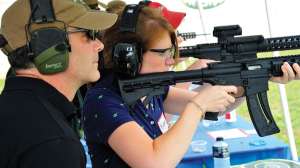
The CMP is actually a federally chartered U.S. nonprofit (legally the Corporation for the Promotion of Rifle Practice and Firearms Safety) whose job is to teach firearms safety and marksmanship (with extra emphasis on youth programs) as well as run shooting competitions. It also operates several shooting facilities and transfers surplus firearms to qualified civilians.
Although not formally organized until 1916, the Civilian Marksmanship program sprang from the War Department Appropriations Act of 1903, which created the National Board for the Promotion of Rifle Practice (NBPRP) and the National Matches, which CMP oversees to this day. The office of the Office of the Director of Civilian Marksmanship was established in 1916 to oversee the effort, and until 1996, the organization was under the Department of the Army. Unfortunately, its efforts stalled in this role, so the CMP corporation (a federally chartered nonprofit) was created when Congress privatized the program that year.
I can offer the following information for those interested in buying one of these prized firearms, which is common for all CMP purchases:
You must be:
• A U.S. citizen
• Age 18+ (21+ in CA, FL, IL, HI, NY, DE, NJ, RI, VT, WA and DC)
• A member of a CMP-affiliated organization. Club membership cannot be waived.
• Legally eligible to possess a firearm (NICS check)
• Able to show marksmanship activity (military/LE service, competition, hunter education with live fire, C&R/FFL, hunting license, etc.). Proof of marksmanship is waived for buyers over 60 on surplus rifles.
Of these requirements, the one you need to get a head start on now is joining a CMP-affiliated group and start shooting with them.
Additionally, as this is a firearms purchase, state-specific rules still apply (FFL transfer required in some states; extra permits in NY, CA, etc.; RI currently cannot receive semi-auto rifles from CMP).
Don’t forget: Proceeds from the sale of these and other historic firearms allow the CMP to teach firearms safety and marksmanship, conduct competitions, and provide scholarships and youth programs, nationwide.
Visit CMP.org for the latest information.