
I sometimes wonder if the shooting sports industry could exist without arguments. From 9mm versus .45 ACP, first versus second focal plane, the relative merits of the 6.5 Creedmoor, or your favorite brand compared to your friend’s favorite, the entire system seems to run on controversary, debate and friction. Still, tactical lever guns seem to provoke as fervent and polarizing response as anything.
I can kind of understand why that’s the case. The lever gun may be the most romantic of all firearms. It was the lever gun that won the West, that we saw in the hand of Rooster Cogburn, Hogan, or Hoss Cartwright. More than a few of us have some cowboy avatar in our mind that is the icon of the lever gun, the American West, and all the history that goes along with it.
What appears in our mind when we think about a lever gun is usually some blend of blued steel, walnut stock, and maybe a brass receiver. It isn’t a gun that’s entirely black. It doesn’t have M-LOK slots or Picatinny rails.
For many, the tactical lever gun prompts a response akin to Dr. Malcolm in Jurassic Park. The engineers were so preoccupied with whether or not they could, they didn’t stop to think if they should. Yet, plenty of shops are finding buyers for these chimera arms, one part old, one part new, entirely useful. If you aren’t selling them, here’s how you need to think about it.
The Case for Tactical Levers
While gun laws have expanded generously in a huge part of the country, there are still states holding out on letting gun owners move into the 21st century. Bans on magazine capacity, furniture configuration and the like make for some non-permissive states in this largely gun-friendly country.
For shop owners in those states, you can lean into state-compliant models, or look to different configurations all together. The tactical lever gun is one such configuration. Because lever guns employ a tubular magazine that does not detach, that particular caveat is worked around. Capacity is also not usually an issue, as most modern lever carbines have a capacity of five rounds for traditional rifle chamberings, and seven or eight for pistol-round variants.
As a stand-in for the AR in non-permissive states, the lever-action rifle is a viable solution. While you give up a little bit of potential magazine capacity, the real argument goes to rate of fire for self-defense.
While it’s debatable if you should really be using your Bill Drill times as exhibit A in a self-defense case, with a little bit of practice, you can achieve more than respectable times running a lever gun. While no speedster, I’ve turned in times barely over three seconds running a Bill Drill with a lever-action carbine.
Manageable Munitions
Shotguns aren’t for everyone. While I’m a big fan, I can see where some people just don’t want to deal with the weight and bulk of shotgun ammunition, or the recoil shotguns can dole out. Similarly, even where legal, some people just aren’t comfortable with the idea of owning an AR-pattern rifle. Again, not my feelings, but those folks exist.
Handguns do not offer the same fast curve to proficiency that long guns do. Moreover, if someone isn’t going to invest some time in maintaining the skills they achieve, they will deteriorate more fully with a handgun than a long gun.
What is left is a bolt-action rifle, a single-shot rifle, or the lever action. Of these, only one is really a viable option for home defense, in my opinion.
While chamberings have expanded in recent years, the most common options are going to be popular revolver calibers: .357/.38, and .44 Mag. While there are also rifle rounds like the .30/30 or .45/70, I think it makes sense to focus on the shorter-range options when making the case for home-defense lever guns.
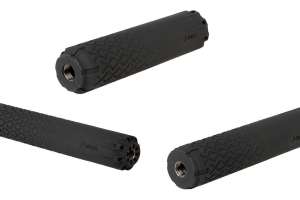
I am especially fond of the .357/.38 setups. For the use case we’re outlining here, there’s just so much in their favor. The tamer .38 loads are a downright pleasure to shoot, and they shorten that learning curve even further by their tame nature. Additionally, should you choose to pair your rifle with a suppressor, the already subsonic .38 rounds become almost Hollywood quiet, as has been the case with my own Marlin Dark Series Model 1894 shooting 158-grain LSWC ammo. The action itself is louder than the report of the rifle when paired with the GSL Technology Stealth suppressor.
Real-World Application
No, a tactical lever gun doesn’t have the same warmth of a traditional blued and walnut version of yesteryear. That doesn’t mean it isn’t without purpose. When used as a home-defense gun, which I think is a fantastic use case for the tactical lever gun, that black gun furniture isn’t just for show — it’s for work.
As a lot of home-defense encounters happen after dark, lights are a consideration. Running a handgun with a handheld light is possible using any one of several techniques, like the harries or FBI options. But running a handheld light with a long gun just isn’t practical. If you’ve ever taken a tactical long gun course with a rifle or a shotgun you know there’s just too much to keep under control to be worried about dedicating an entire hand to a flashlight. So a gun-mounted light is called for, but where exactly would you propose mounting a light on a non-tactical lever gun? On the other hand, a tactical lever-action makes it easy.
Tactical lever guns provide another option for home defense, that is not only practical, but incredibly viable. It may not be the choice for everyone, but there’s no reason to dismiss out of hand another reasonable rifle configuration to help your customers stay safe in their home, or just have fun out at the range.
If you’ve been putting off adding tactical lever guns to your wall, maybe it’s time to reconsider.
Good – Better – Best
If you’ve read much of what I’ve written, you know that I am a sucker for the good-better-best setup when moving products. If you think you have enough of a base to move the tactical lever guns in your area, keep in mind you will also have clients with different budgets to manage. While I am a fervent believer that we are lucky to live in the golden age of firearms, and it is truly difficult to purchase a lemon, there are differences between the price points. Here’s a few you should consider to hit the needs of all the customers you may have.
GOOD – GForce Arms Saddlehorn LTAC
Manufactured in Turkey, the GForce Arms option brings many of the same designs and features that we will see in our other offerings, but in a budget-minded package. A 16.5-inch barrel makes for a maneuverable and manageable platform with an 8+1 capacity, and is threaded to accept a suppressor. Chambered in .44 Mag or .357/.38, the rifle weighs in at 5.5 pounds, suitable for shooters of all sizes. Multiple finish and stock options are available, but they all feature a Pic rail for optics and M-LOK forend. The oversized lever loop is a nice touch. MSRP — As low as $779
BETTER – Citadel Levtac 92
The Citadel is configured much the same as the GForce, with the oversized loop and 16.5-inch threaded barrel marrying to the lever-action receiver. The Citadel integrates a rear peep sight into the Pic rail should you choose to deploy the rifle without another optic. The Citadel is also an 8+1 magazine configuration, but is a bit more robust, weighing in at a little more than 7 pounds, but that extra weight is still easy to handle, and it helps to mitigate recoil should you opt for the .357 ammo rather than the .38. MSRP — $899
BEST – Marlin Dark Series Model 1894
The Marlin lever gun legacy is well established, so we won’t dive into all of that here. Since being revived by Ruger a few years ago, the Marlin brand has returned to its roots while keeping an eye on the future, and nowhere is that more evident than with the Dark Series Model 1894. The classic stock lines are eschewed for nylon reinforced polymer with integrated flush cup sockets for QD sling attachment. The M-LOK forend marries well to the receiver, which is topped with an extended Pic rail that can accommodate multiple optic configurations. A forward QD socket is integrated into the forend. The Marlin splits the difference of our other two options, coming in right around 6.5 pounds. MSRP — $1,429
AMMO OPTIONS
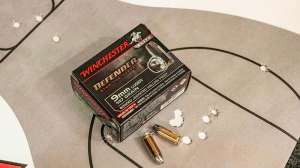
Why not double up that sale by adding a revolver in the same chambering to that tactical rifle cart? Two guns, one ammo. Seems simple, right? While I am a huge proponent of marrying lever guns with revolvers for a home defense plan, finding ammunition solutions that work for both lever-action carbines and shorter-barreled revolvers has proven difficult over the years. I recently tested 16 different ammunition options, eight .38 Special and eight .357 Mag, out of a Marlin Dark Series Model 1894 and a Ruger GP100 Match Champion revolver to see how much variance there was.
Overall, I was amazed at how consistent the ammunition was in both platforms at five and 10-yard distances for the revolver and 10- and 25-yard distances for the rifle. Overall, the .38 Special kept things just a little tighter, with a little more than 13% smaller groups and almost 16% smaller group spread.
Most groups were well beyond acceptable, with only four groups of the 64 that were shot having an outside measure exceeding three inches. That said, a few of those groups were a bit too far from point of aim to be considered a viable option for my particular pistol and rifle.
For my taste, unless you want your defensive ammunition to pull double-duty as a hunting round, I can’t see the logic in using .357 in place of .38 Special. Plenty of good work has been done with the .38 Special over the years to consider it a viable self-defense option, especially when given the added benefit of a carbine-length barrels.
Regardless, a small investment of time and money in a few ammunition options should yield a single defensive round that will work from both rifle and pistol.