
Sales are lagging at many tactical retailers. Hopefully you’re not among them, because the fix can be elusive, expensive and never guaranteed, and it rarely works overnight.
Sharing knowledge and delivering quality service builds customer loyalty and eases the slowdown pain, but sometimes it’s not enough to get the cash register to ring. You likely already have a generous supply of gear on hand for pursuits popular nearby, but it may be time build on that foundation.
Consider offering a modest inventory of accessories or upgrades for historically popular guns, even those not associated with tactical use. The Ruger 10/22 is a good example. The company wouldn’t share the precise number sold to date, but in late July it told us we wouldn’t be wrong in reporting more than 9 million have been purchased since its 1964 introduction. It always remains at or near the top of GunBroker.com’s monthly list of best-selling semi-auto rifles.
More than a few are already owned by your loyal customers, and they continue to sell. Stocks available from the factory stock are still somewhat limited. Combined with the thousands of hand-me-downs with scarred wood or polymer, thousands of Ruger 10/22s are begging for cosmetic upgrades and/or modern convenience.
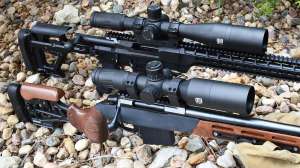
Many of the aftermarket stocks available today have looks befitting a tactical retailer’s wall, wearing rails, MLOK forends and more. They are relatively inexpensive, installation is simple and the steps are straightforward.
Begin by determining the Ruger 10/22 model the customer wants to upgrade. Not all are equal. For illustration purposes, we used a Takedown model, which doesn’t quite have the variety of aftermarket stocks available as standard versions. It also requires an extra step. If the gun has a bull barrel, ensure any selected stock will fit by consulting the manufacturer’s website or packaging. Some companies employ a removable insert, like seen here, that is simply removed to accommodate the beefier profile.
As always, safety comes first and foremost once the customer has selected the stock. First engage the safety if it is not already in that position.
Then remove the magazine and lock back the charging handle. Look closely in the chamber to ensure no round remains. Check twice and use a flashlight if necessary — .22 rimfires aren’t exactly huge.
Open the selected aftermarket stock’s package. Inventory parts, inspect for unacceptable blemishes or burrs and consult the manufacturer’s instructions. Odds are good the only tool required will be a screwdriver.
Some, but not all, Ruger 10/22s have a barrel band that wraps around the forend. If one is present, take it off.
Now you’re ready to remove the bolt or bolts anchoring the original stock. The takedown has two, standard versions one, and they are under the stock.
Skip this step if you’re not dealing with a Takedown. Remove the forwardmost bolt and separate the forend from the barrel.
Back the bolt in front of the mag well completely out — you’ll probably be reusing it. Rotate the barrel slightly up to clear it and the front of the receiver slightly from the stock. Then carefully pull the metalwork forward. The angle allows it to clear a slot in the stock that helps keep things anchored, somewhat akin to a recoil lug on heavier-caliber rifles.
If it doesn’t come free with ease, take a close look at the safety. It may need to be carefully moved to its “middle” position during removal. It depends largely on stock design and maintenance, but that’s the first place to look.
If the 10/22 has a bull barrel, you may need to remove an insert in the new stock’s forend for clearance. Do so if needed.
Now you’re ready to reassemble. With a Takedown, align the forend, insert and tighten its bolt.
On standard versions, and to install the separate buttstock on a Takedown, align the receiver and barrel in that slightly rotated position. Then push the stock forward until flush with the lug, rotate the two pieces together and things should snap into place. If not, check if the safety position is the culprit. Insert the bolt forward of the mag well, tighten and you’re nearly done.
Perform a function check to ensure nothing binds or any adjustment is required. In this case, none were needed, although the instructions included minor alignment procedures.
Now you’re ready to hand the rifle back to another satisfied customer. Of course you should recommend a range session, .22 LR ammo you have in stock and maybe a spare magazine to fill this stock’s hidden storage compartment under the cheekrest.