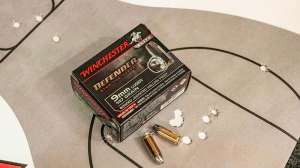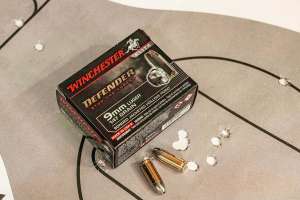

The 9x19mm Parabellum is the reigning champion of the defensive handgun world, and there’s no denying it’s logical. Not only is 9mm a highly effective defensive cartridge, but it’s also reasonably easy to handle when it comes to felt recoil, muzzle rise and accuracy. Then there’s the fact that the firearms market is flooded with handguns chambered in 9mm. It makes sense that your store’s shelves are weighed down with endless stacks of 9mm…or does it? Here’s why you should branch out beyond 9mm for customers focused on self-defense, and what calibers to consider.
There’s More to Life Than 9mm
Seeing 9mm as the end-all, be-all for handguns is a mistake. You might alienate customers who simply dislike it, whatever their reasons may be, and you’ll lose sales from customers interested in something either smaller or larger. Your team should remain open-minded and take the time to broaden their education on handgun calibers — your profit margin will thank you for it.
Injuries, Weakness, and Fear
Customers of both genders approach the gun counter with entire histories you and your team know nothing about. It could be a matter of injuries — visible or not — or it might be an issue like debilitating arthritis. Maybe they have a surgery coming up, which is really none of your business, and are aware they need a small caliber to remain armed. And if they’re frail, whether due to age or illness, odds are they’re going to be extremely aware of size and recoil. As for fear, a lot of people are afraid of the unknown but are still aware enough to want to learn more. There’s a wide range of customers that can be instantly alienated or lost if assumptions are made, and that alone is a good reason not to focus only on 9mm.
Diminutive Can Be Defensive
We all want to recommend customers go for larger calibers for self-defense use because they’re simply more effective. Smaller calibers such as 22LR are, well, small. They simply don’t make large permanent wound cavities and their penetration tends to be lacking as well. However, there are myriad cases where 22LR was used to great effect in defensive scenarios (just ask any ER doctor or surgeon). When something is stopping a customer from running a bigger gun, it’s better to steer them to 22LR than to hand them a canister of pepper spray.
Is 9mm Enough?
There are cases where 9mm is too small. This is why you should ask customers questions, without being too invasive, to find out what they want the gun for. If your customer spends time hunting or working in fields, going larger than 9mm is wise. Switch it up to 10mm and the customer gains a serious edge against charging bears and feral hogs (yes, hogs will charge you). Not everyone can purchase or wants to purchase multiple handguns, and 10mm is a good multipurpose caliber.
22LR: Rimfire Realities
The most widely available small caliber to suggest for customers who need it is 22LR. Defensive loads do exist, such as Federal Personal Defense Punch 22LR 29-grain Nickel Plated Flat Nose. It’s a bit cliché but true that ensuring a customer has a gun available for self-defense is better than that person having nothing. Add in making sure you have the best possible defensive ammunition in stock and it becomes exponentially better.
As for defensive handguns chambered in 22LR, keep in mind that customers requiring a rimfire gun for protection will also have specific restrictions for the firearm itself. For customers with the finger strength necessary to load magazines, the Walther P22 Q is a great gun. It’s a subcompact with a 10 +1 capacity, aggressive slide serrations, and an accessory rail in front of the trigger guard. It’s a double-action/single-action gun, so take the time to confirm your customer can reliably pull the trigger.
If the customer struggles to rack the slide on a semiautomatic handgun, show them a revolver. The Smith & Wesson Model 63 is a 22LR with an eight-round capacity. A 3-inch barrel keeps the gun compact enough for concealment, and the stainless steel frame gives it enough weight to reduce felt recoil. Keep in mind that while the average shooter might not remark on felt recoil from a rimfire handgun, a shooter in need of certain accommodations will notice.
380 ACP: The 9mm’s Little Cousin
The 380 ACP is a nice fit for customers looking for greater capacity and reduced recoil in a full-sized handgun. When this caliber is used in a compact or micro handgun, felt recoil gets snappy, and many shooters dislike it. However, if your customer just likes the caliber, go ahead and steer them to the pistols with greater muzzle rise. While 380 ACP is smaller than 9mm and doesn’t deliver the same level of penetration, it’s a viable option for defensive use.
A micro-compact in 380 ACP that manages to be a quality pistol for weaker hands is the Smith & Wesson Shield EZ. The key is to ensure the customer has the grip strength necessary to keep the grip safety compressed during live fire. Beyond that, this pistol is surprisingly easy to operate and a good one to stock for older or injured customers.
10mm: All-Purpose Defense
The 10mm is gaining increasing popularity for good reason: This is an excellent load for defense against two- and four-legged threats. Something like 9mm is iffy for angry animals, but 10mm gets it done. Same goes for two-legged attackers amped up on drugs or rage, because this is the caliber that takes energy transfer to the next level. It isn’t going to be ideal for every handgunner who walks through your doors, but it will fit more of them than you might realize.
Stock the Sig Sauer P220 Legion in 10mm for a sub-$1k pistol that’s beautifully made right out of the box. Both double-action/single-action and single-action-only are available, and each has its pros and cons. This gun has an 8+1 capacity. Keep Hornady Backcountry Defense 10mm 200-grain JHP on hand for customers in need of defense against angry four-legged attackers. For the usual self-defense, stock Federal Premium Personal Defense Punch 10mm 200-grain HST.
38 Special: One to Remember
It’s common to suggest revolvers chambered in 357 Magnum, but don’t forget the usefulness of 38 Special. This caliber offers solid ballistics and less felt recoil than its magnum sibling, making it a better choice for a lot of gun owners. It’s also a good enough seller to stock both snub-nosed and larger revolvers chambered in it along with an assortment of speedloaders and holsters.
The Colt Cobra in 38 Special +P with a 2-inch barrel is perfect for concealed carry. Its six-round capacity does make suggesting the customer carry a speedloader a good idea, although not a must. An overall weight just over three pounds does make this a heavier gun, but that’s great for reducing felt recoil. And if customers prefer a longer barrel — because not everyone loves a snubby — there’s a 4-inch-barrel model. Consider keeping both barrel lengths on the shelf.
Pocket Pistols: Still a Thing
Most customers looking for a pocket pistol will gravitate toward double-action-only, snub-nosed revolvers. Some prefer micro-compact semiautos or even derringers. What almost none of them will be asking for is a 9mm pistol created for pocket carry.
When your team is assisting a customer in their quest for the perfect pocket pistol, it helps to remember a lot of people will drop that gun in their pocket without a holster. You can and should suggest they use a quality pocket holster, but it can’t be forced. This is why heavier triggers and revolvers tend to rule the pocket pistol world. Calibers also tend to include 357 Magnum, 32 H&R, 380 ACP, and 22LR. That doesn’t mean there aren’t any good 9mm pocket pistols you can stock, but we’re not talking about that caliber here.
The Caliber Bottom Line
According to Firearms Academy of Seattle firearms instructor Diane Walls, who specializes in handguns, the caliber issue can be rather neatly summarized: “45 ACP in a medium-sized gun with a lighter, faster round than the common 230-grain is quite manageable. 380 ACP is marginal, but the defensive ammunition has improved for people with recoil sensitivity. If [a customer] is very challenged for recoil, 22 Magnum or 22LR could do if the shooter trains in tactical anatomy and accuracy.”
It always comes down to shot placement. The 9mm won’t stop a threat if it doesn’t hit the target correctly; 22LR can drop an attacker with shocking speed when the point of impact is precise. Encourage customers to select a caliber that they can manage with accurate follow-up shots rather than just jumping right to 9mm every time. Shot placement and shots on target matter, and that’s why 9mm isn’t a good fit for every person who walks in your doors.